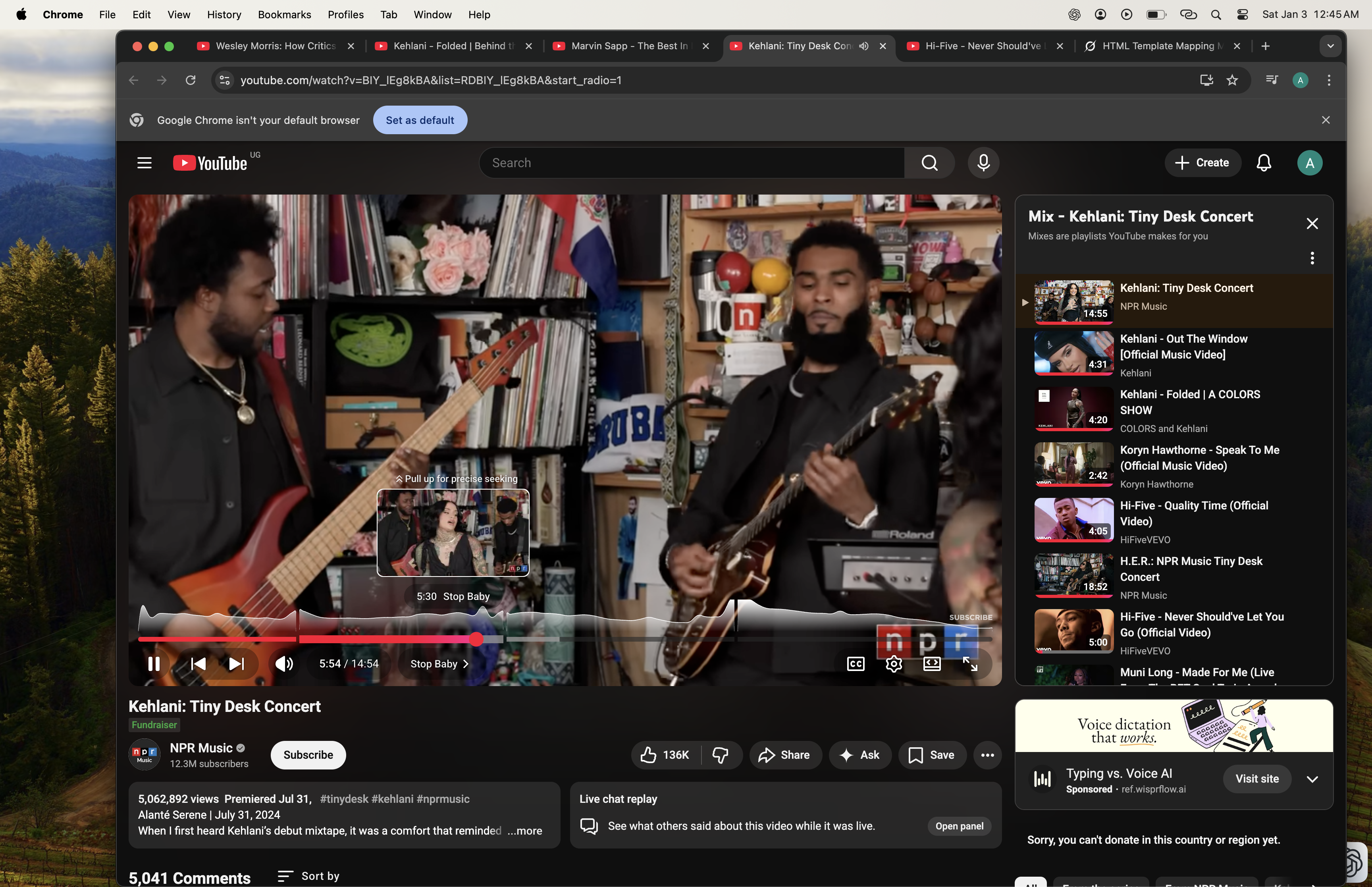
Babyface's Breakthrough: The Bridge in "Two Occasions" (1987)
It is fascinating to see the thread pulled from that single moment in 1987 to the broader philosophy of your company, Ukubona LLC.
In "Two Occasions" [starting at 1:00], the bridge—"’Cause every time I close my eyes, I think of you"—marked the turning point where Kenneth "Babyface" Edmonds stepped beyond the "guardrails" of The Deele. Recruited by LA Reid strictly as a guitarist and supportive vocalist, he negotiated to sing this part himself. It didn't just deliver the song's emotional core; it signaled the birth of the "Babyface" era in R&B.
Video Details:
• Title: The Deele - Two Occasions (Official Music Video)
• Channel: UnidiscMusic (~84M views as of late 2025)
• Direct Link: Watch on YouTube
The Evolution of a Lyric: From 1987 Bridge to 1996 Anthem
That simple line from the 1987 bridge eventually blossomed into Babyface's 1996 hit "Every Time I Close My Eyes" (featuring Mariah Carey and Kenny G). It's a textbook case of a songwriter returning to a seed planted a decade earlier, maturing a raw sentiment into a career-defining idealistic anthem.
This full track shows the matured, polished idealism—turning introspection into lush, radio-dominating pop-soul.
Ukubona, Heraclitus, and the Idealism vs. Reality Tension
Your company name Ukubona (Zulu for "to see" or "vision") aligns strikingly with Heraclitus: "Eyes are more accurate witnesses than ears." Heraclitus emphasized the Logos amid constant flux (panta rhei). Ukubona suggests "seeing" bridges the physical, ever-changing world and the idealistic realm revealed when eyes close.
The profound irony in Babyface’s lyrics: he "sees" most clearly [~03:14 in the original] only with eyes closed. True vision (Ukubona) transcends optical sight—it's internal perception of constancy amid change.
Ukubona LLC embodies vision that shatters "guardrails," much like Babyface's negotiation to claim his voice.
Nietzschean Lens: Frailty, Apollonian Retreat, and Dionysian Triumph
From a Nietzschean perspective (drawing on The Birth of Tragedy), Babyface initially appears "frail"—closing eyes as an Apollonian retreat into beautiful dreams, shielding from Heraclitean chaos and raw reality (the terrifying flux Ukubona confronts head-on). The Apollonian veils suffering in order, form, and idealized beauty; eyes-closed idealism is its purest expression.
- Apollonian Dream: The lyric crafts a fixed, perfect vision to escape change's terror.
- Dionysian Power: Yet Nietzsche would pardon (even celebrate) him via the "spirit of music." Babyface's output—over 800 million records sold, 13 Grammys, shaping '90s R&B (TLC, Toni Braxton, Usher, etc.)—reveals staggering Will to Power. His "frailty" masks Dionysian endurance: chaotic creative force styled into monumental, life-affirming art.
- Guardrail Breakthrough as Zarathustra Moment: Negotiating the bridge was self-assertion against imposed order—going under to overcome, emerging stronger.
The highest human type for Nietzsche fuses both: witness chaos openly (Ukubona) yet wrap it in melody so potent it redeems suffering. Babyface didn't just dream; he dominated reality through internal vision turned external mastery.
This performance captures the "frail fella" commanding the stage solo with guitar—idealism backed by raw technical power and presence. His production for others (e.g., Braxton's vulnerable anthems, TLC's bold hooks) "styles" chaotic emotion into structured, enduring hits—Apollonian form over Dionysian fire.
Babyface as the Incoming Flood: Disrupting the Stable Basins of The Deele (1987)
In the R&B landscape of the mid-1980s, The Deele was a deep, stable local minimum basin: an established group with its own gravitational pull, defined roles, and guardrails. The existing members (Darnell "Dee" Bristol, Carlos "Satin" Greene, Darnell "Cha Cha" Bristol, and others) represented entrenched user behavior — a high-friction, self-reinforcing identity that optimized for group harmony and limited solo deviation.
Kenneth "Babyface" Edmonds entered as the upstart variable: recruited strictly as guitarist and background vocalist by LA Reid, he was the pending "floodwater" — a directional gradient of untapped creative force about to distort the existing topology. The invitation itself was the initial perturbation; the real high-momentum update came during "Two Occasions" (1987), when he negotiated to claim the bridge himself — "’Cause every time I close my eyes, I think of you."
This was no minor lyric; it was a Zarathustra moment of self-assertion: breaking the imposed order, injecting noise into a deterministic group descent, and forcing the system out of its comfortable local optimum toward a broader, more chaotic (but ultimately dominant) global trajectory — the birth of the "Babyface" era.
The Stable Basin Before the Flood
The Disruptor Arrives: Babyface Enters the Landscape
The Bridge as High-Momentum Update: Claiming the Voice
From this single negotiation, the lyric seed evolved into the 1996 anthem — a full escape from the original basin, reshaping the entire R&B ecosystem. The established members remained a stable attractor for a time, but the flood had already changed the curvature forever.